
Two families make offers on the same $900,000 condominium. One has cash from an earlier sale or family wealth and pays the price outright. The other has saved a 20% down payment and borrows the remaining $720,000, which triggers a $13,860 mortgage recording tax at the closing table while the cash buyer owes nothing.
New York’s deeper problem is a housing shortage that will take years to build out of. With the city’s rental vacancy rate at 1.41% in 2023, according to the Housing and Vacancy Survey, Mayor Zohran Mamdani’s administration put 12 community districts on a fast track for affordable housing on 1 October. Those districts produced just 724 of the city’s 63,870 new affordable homes over the past five years.
While those apartments are being planned, state and city lawmakers could make buying a first home fairer right away by fixing how New York taxes the closing table and records its sales. In my dataset linking 729,047 residential sales from 2016 through 2025 to recorded deeds and mortgages, four fixes stand out that require no new construction and no net loss to the public budget.
1. Move the tax off the mortgage
In ten years of New York City records, the closing-table tax burden falls hardest on ordinary households who need a bank. More than three in four home purchases between $500,000 and $1 million carry a recorded mortgage (76.7%), compared with two in five purchases at $5 million and above (40.0%). Among buyers who purchase without a recorded mortgage, 42% are companies.
Because New York charges borrowers 1.8% on residential mortgages under $500,000 and 1.925% on loans of $500,000 or more (minus $30), the tax takes a large bite out of the savings a family brings to closing. From 2023 through 2025, the typical financed buyer owed about $12,700 in mortgage recording tax, equal to 5.8% of their down payment. In Manhattan, where the median down payment was $492,500, the tax took 4.5% of the buyer’s cash. In the Bronx, where the median financed home sold for $706,500 and the typical down payment was $111,600, the $11,240 mortgage tax swallowed 7.7% of what the family had saved.
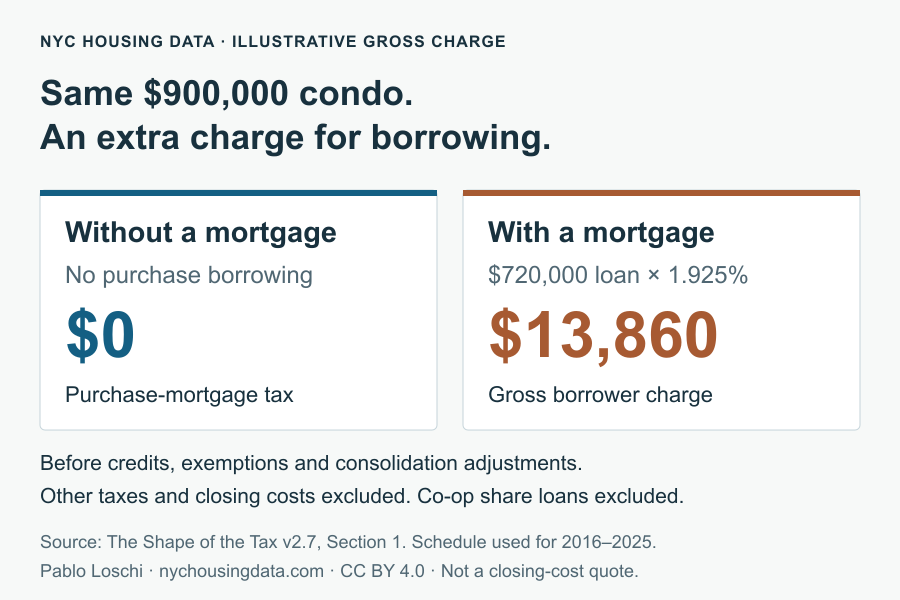
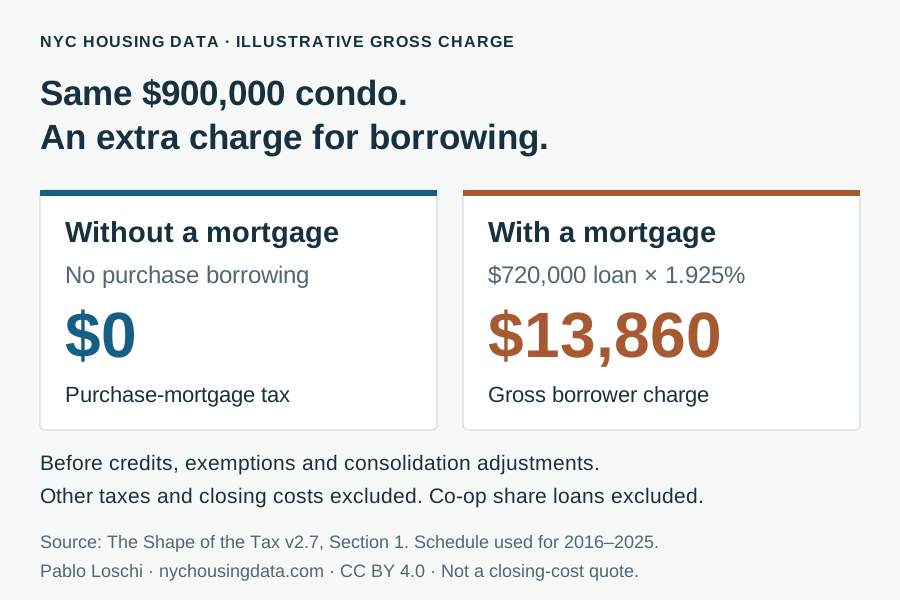
Across financed house and condo purchases between $300,000 and $6 million in four boroughs, the gross statutory bill averages about $244 million a year before credits and exemptions. Albany and City Hall could collect the same $244 million by shifting the charge off the loan and onto the purchase price for all buyers, financed and cash alike. A flat 0.88% rate on every sale would cut the bill on that $900,000 condo from $13,860 to $7,920, saving a borrowing family nearly $6,000 upfront, and would cut the typical Bronx borrower’s bill from $11,242 to $6,217, saving about $5,000. Leaving the first $500,000 of every sale untaxed and charging 1.56% only on the portion above $500,000 would reduce the $900,000 condo buyer’s bill to $6,240, a saving of more than $7,600.
Under either replacement, about nine in ten buyers with a mortgage would pay less, around $5,000 on average, while cash buyers would pay $11,000 to $13,000 more. Because part of today’s mortgage tax goes to the MTA, any swap would need to keep that dedicated transit funding intact. More on the recording tax.
2. Charge each rate on a slice of the price
Rewriting the schedule would also let lawmakers eliminate New York’s “slab” tax cliffs, which trigger a higher rate on the entire loan or purchase price the moment a deal crosses a threshold by a single dollar. A first-time buyer who borrows $500,000 instead of $499,999 owes an extra $625 on the spot because the 1.925% mortgage rate reaches back to the first dollar borrowed. At a $1 million purchase price, now just below the $1,025,000 median price of a financed home in Brooklyn, the state’s 1% mansion tax switches on all at once and adds $10,000 to the first dollar over the line. At $2 million the step is $5,000, and at $5 million it reaches $37,500.
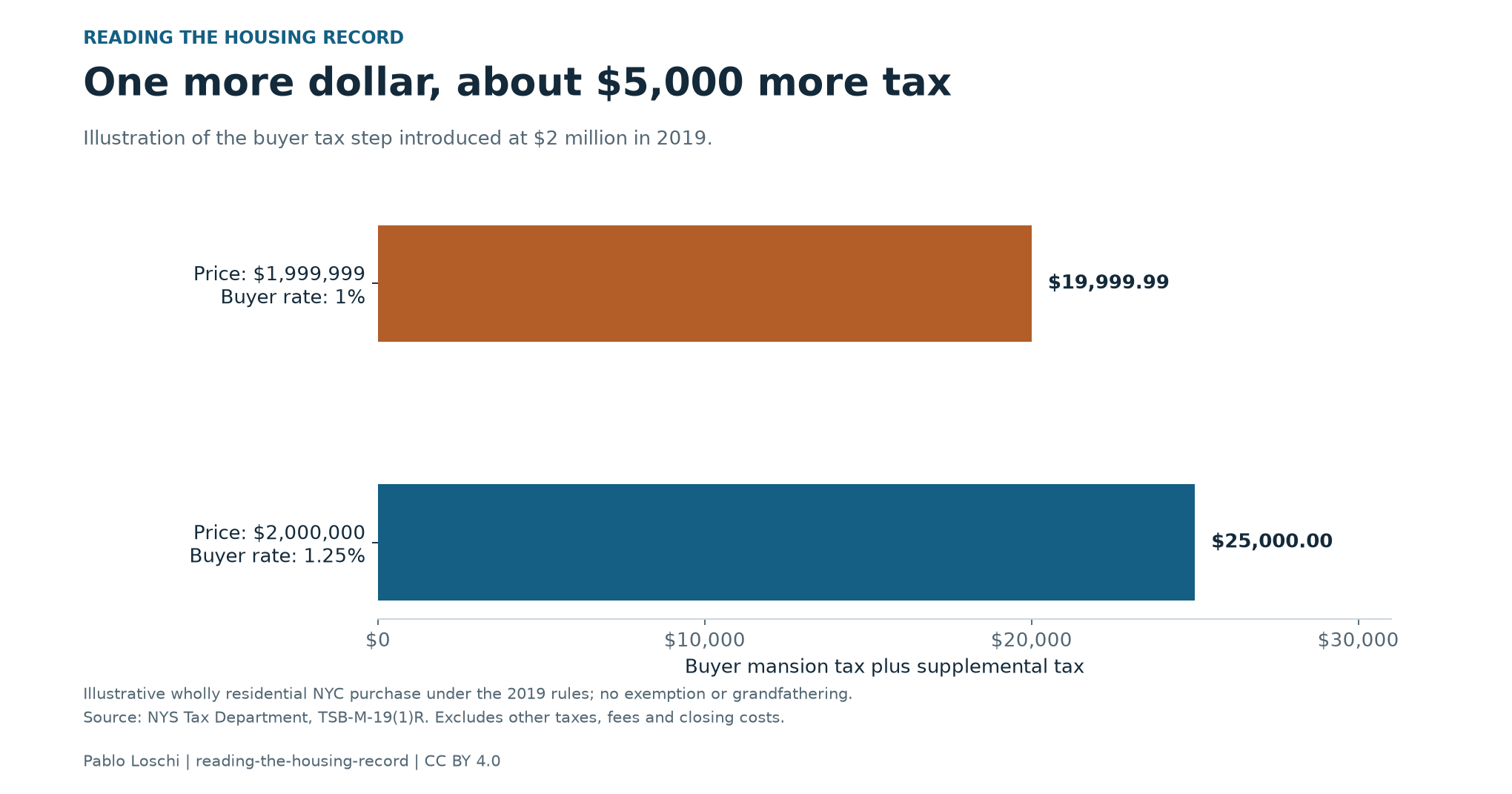
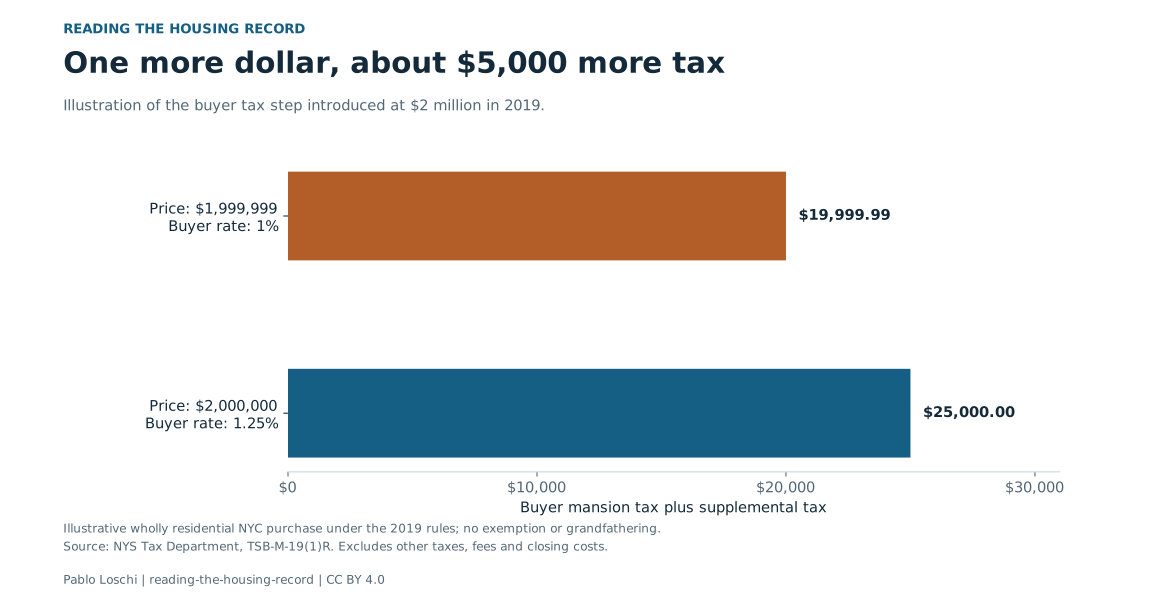
When the state added higher steps at $2 million, $3 million and $5 million in 2019, about six in ten sales that would have closed at those exact round numbers shifted to a few thousand dollars below the line (deeds at $1,999,999 rose from 4 before the change to 127 after it, and deeds at $4,999,999 rose from 0 to 26), while the remaining buyers at the round number paid the full jump. Across the river in New Jersey, where a 2004 buyer fee of 1% exempts a sale at $1 million and applies to the whole price above it, the share of sales at the line still fell 91%. The full story of the $2 million line.
The United Kingdom ended the same distortion in December 2014 by converting its stamp duty to marginal brackets like the income tax, where each rate applies only to the slice of the price above its threshold. For New York sales of $2 million or more since 2020, a marginal slice schedule would raise the same $296 million a year without artificial price cliffs, with 7% of those high-end buyers paying more than they do today.
3. Check the cash discount before taxing it
The mayor’s March tax package went the other way, with a 1% tax on cash purchases above $1 million (Realtor.com). The state budget left it out in May, but the idea could come back.
The pitch for a cash-buyer surcharge rests on the belief that cash buyers get a steep discount at the expense of families who borrow. In raw city records, houses bought without a mortgage do appear to sell for about 9% less than the same houses bought with a loan. In my repeat-sales analysis, however, about half of that gap disappears once sales between people with the same surname are set aside. The state transfer reports filed with the deeds point the same way. In a random sample of 60 deeds, whose reports I read with AI assistance and then checked against the forms myself, 16 of the 40 same-surname deeds declared a sale between relatives or showed another non-market sign, against 2 of the 20 other cash deeds. The sample is too small to say how often the surname flag is wrong. When a company pays cash, the gap that remains is too small to distinguish from zero. How the cash discount shrinks.
Folding the mortgage recording tax into a smooth purchase tax on all buyers levels the playing field between cash and financed offers directly, without relying on a discount that shrinks by half once likely family transfers are set aside.
4. Publish the deed number and flag non-market transfers
Better housing policy also requires cleaner public records. Every New York City deed is filed with a state transfer report (Form RP-5217NYC) whose item 14 asks the parties to tick a box if the sale is between relatives or former relatives, between co-owners, or otherwise unusual. The city’s open sales file leaves those checkboxes out, and it does not list the registry document number that links a sale to its recorded deed. Linking sales to deeds requires matching rules that find a deed for 96% of condo sales in Brooklyn, 90% in Queens and 88% in Manhattan, but only 52% in the Bronx.
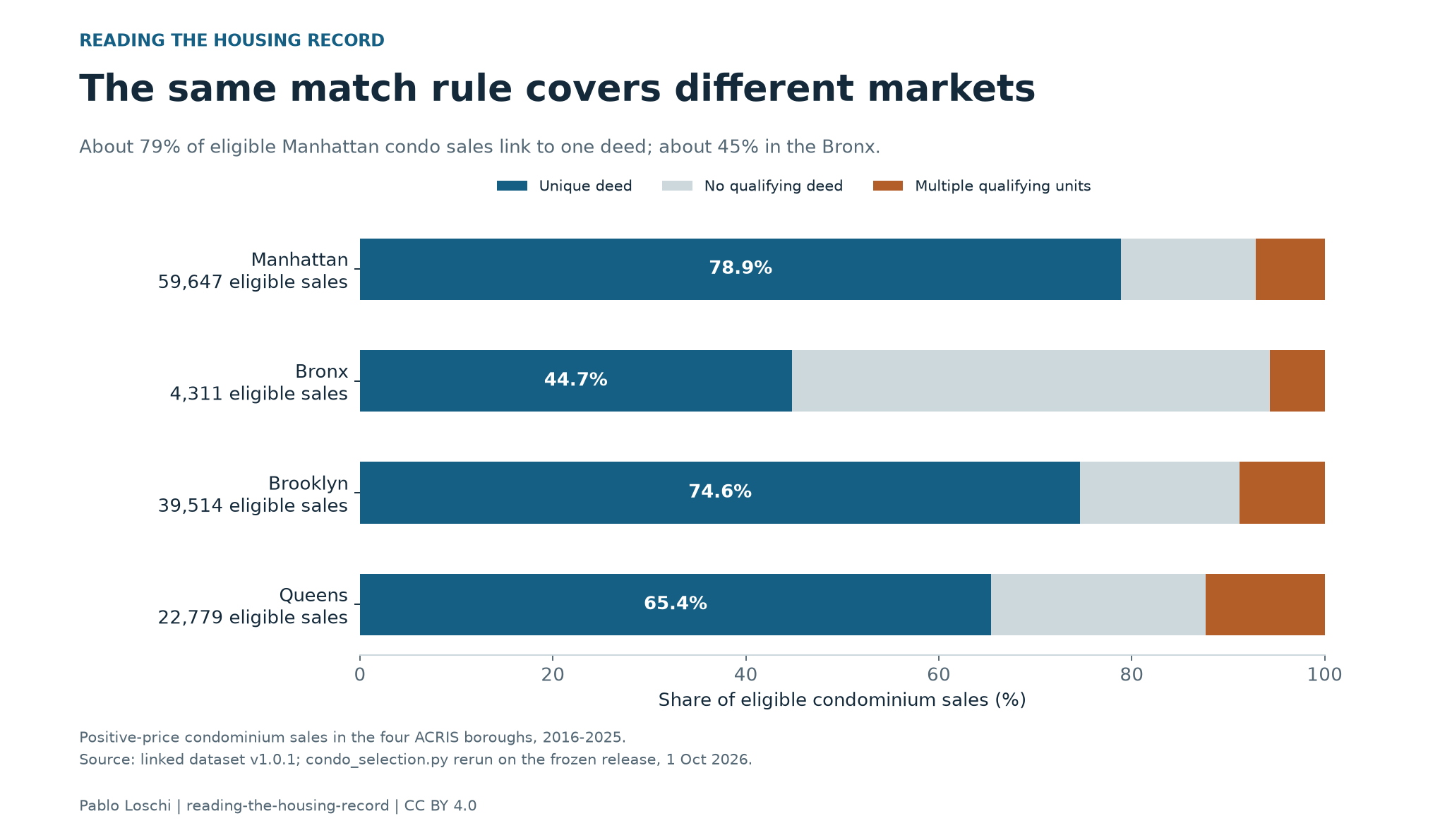
Foreclosure transfers to lenders also sit in the public sales file at amounts set by debt or tax rules rather than market bidding, bending price indexes in the neighborhoods where foreclosures were concentrated. Publishing the state transfer-report checkboxes, the deed document number and a foreclosure flag in the open data would let anyone separate family buyouts and distressed transfers from market home purchases. The Bronx condo gap · Foreclosure deeds in the sales file.
The same principle applies when governments evaluate housing programs. When I reran a published simulation model of housing and poverty programs in Brazil, monthly cash aid appeared to reach 170 times as many households as a program that bought homes for poor families, because the count added up monthly payments. Counted as distinct families, the gap was 2.3 times.
Limits to keep in mind
Reforming closing taxes and opening the records will not add a single apartment to New York’s housing stock. The revenue-neutral tax figures hold the set of sales fixed to show the arithmetic of the swap rather than a behavioral forecast of who bears the tax after prices adjust, and a shared surname is an imperfect proxy for family relationships. Even so, there is no reason for a city in an affordability crisis to keep charging first-time homebuyers thousands of dollars extra at the closing table simply because they need a mortgage.
Sources and methods
This article explains Pablo Loschi’s own research. Recording tax, down-payment burden, swap and slice figures: The Shape of the Tax, v3.2, Supplemental Appendix Section I and the slice-schedule table (Zenodo), and linked dataset v1.1.0. Cash discount and transfer-report check: Who Gets the House?, v3.9. Condo coverage: linked dataset v1.1.0. Foreclosure deeds: When a Deed Is Not a Market Sale. Program counts: the PolicySpace2 audit in When the Benchmark Moves with the Policy (audit files).
Official and news sources: NYC HPD, 2023 Housing and Vacancy Survey; NYC Mayor’s Office, 1 October 2026; Realtor.com via Yahoo Finance, 26 March 2026.
Original article: CC BY 4.0. Credit Pablo Loschi, NYC Housing Data; identify edits. Underlying research releases retain their own terms.