NYC Housing Data · Independent research

New York’s housing records, explained

Explore recorded transactions across the five boroughs. See how deed amounts, mortgage matches and tax rules shape the numbers people use to understand the housing market.

Public records, 2016–2025. Frozen research data, with sources and limitations.

Explore transactionsFilter by borough, year, property type and price. Download the numbers behind each chart.Read Housing StoriesShort articles on the cash gap, tax thresholds and amounts that are not market prices.For journalistsFindings, reusable graphics and a direct route to the research and its author.

From Housing Stories

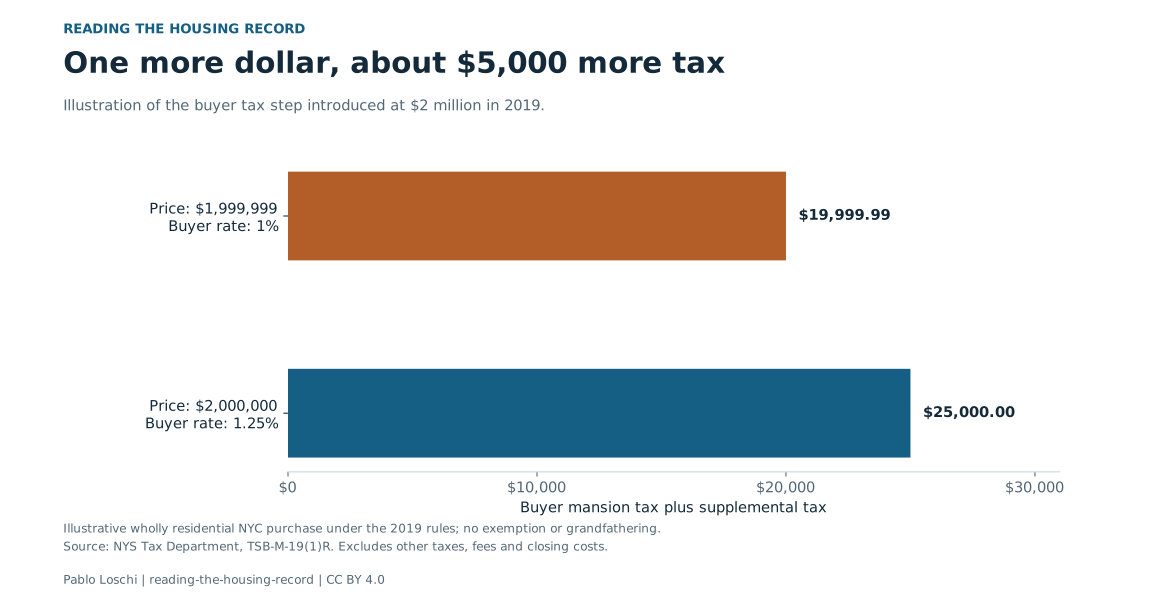
One dollar below $2 million

Under New York's 2019 rules, that last dollar adds about $5,000 to the buyer's tax. The sales records show a shift around the line.

Read the story and get the charts
Illustrative buyer tax rises from $19,999.99 to $25,000 when a residential price rises from $1,999,999 to $2 million, under the 2019 rules.

The papers

Three parts of one record

The amount on the deed, the financing label attached to a sale, and the tax the law assigns to it.

01 / DEED AMOUNTS

When a Deed Is Not a Market Sale

When does recorded consideration follow a legal rule rather than a negotiated price, and what does that do to a price index?

16,655deeds whose recorded amount can follow a legal rule rather than a negotiated price, 2003–2025

Empirical researchExplore paper →
02 / FINANCING LABELS

Who Gets the House?

Does a recorded cash–mortgage price gap reflect financing, or who buys with cash?

9.25 → 4.87log-point house gap, before and after excluding same-surname deeds

Submitted to Journal of Housing Economics

03 / TAX DESIGN

The Shape of the Tax

How did sales shift at the transfer-tax notches created in 2019, and what does that mean for taxing borrowers and cash buyers differently?

7.8 → 1.6sales at exactly $2 million relative to nearby price density, before and after the 2019 reform

Submitted to American Economic Journal: Economic Policy

COMPANION SIMULATION · ILLUSTRATIVE MODEL

The Execution-Certainty Wedge

How Measurement Choices Rank Housing-Access Instruments

If a buyer's certainty of closing, usually a cash buyer's, can decide who gets a home, how would you tell which policy widens access at the lowest cost? The paper compares acquisition caps, fair-share quotas, constant charges and contention-triggered duties in a simulated market, and finds that the answer depends on how access and efficiency are measured.

An efficiency benchmark computed over the buyers still waiting moves with the policy and can reverse the sign of its effect; a two-period example shows why. Access counted over the whole run understates a cohort's gains by up to 2.5 times and reorders the instruments.

The comparison is conditional. Run at New York City proxy values, removing the cash discount lowers the share of owner-occupiers who leave without buying only from 9.8% to 9.5%. The model leaves out strategic bidding, renter welfare and administrative costs. The empirical papers motivate the model without confirming its premise: Who Gets the House? finds that the measured contrast changes with buyer identity and transaction screens; it does not identify the value of closing certainty.

Related methods paper: Auditing policy dependent benchmarks in allocation simulations (PDF) · Code and archive.

Simulation studyExplore paper →

Why it matters

What changes if the records are read carefully

Price indices

Some registry amounts are not prices. Deeds that record a lender taking title pass the usual screens and shift the timing of a repeat-sales index through the 2008 crisis. Classifying deeds by their parties removes them.

The cash discount

Excluding deeds with shared buyer and seller surnames roughly halves the measured house-price contrast. Those names are a proxy for possible related transfers. The result does not identify the effect of paying cash.

Tax design

Recorded prices shift around new tax thresholds. Observed loans also allow a calculation of gross mortgage charges under the statutory schedule. Actual tax payments and who ultimately bears the cost remain unmeasured.

The data

One public record system, three different slices

"Same data" means the papers draw on the same free New York City records. Each paper builds its own sample from them and answers its own question.

Two public sources

Department of Finance sales fileEvery recorded property sale: price, date, address and building class.
ACRIS, the city's land registryEvery deed and mortgage recorded in Manhattan, the Bronx, Brooklyn and Queens: document type, amount, dates, the parcel it touches, and the names and addresses of the parties.

Linked record by record

Parcel (borough–block–lot) + date + amountSales are linked to deeds using parcel, date and amount. Nearby recorded mortgages supply financing flags; a match does not verify purchase financing, and no match does not prove a cash purchase. For condominiums the matched deed supplies the unit lot. Coverage and agreement with earlier code are documented separately from accuracy against verified instruments.
Published as a dataset →729,047 sales, 2016–2025; 277,298 house and condominium sales linked to a unique deed, with mortgages, deed flags, a codebook and the code. No party names. Files, codebook and how to cite.

Sources

All sources are free NYC Open Data. Each paper's archive records the exact extracts it used.

Linked dataset

Deposited on its own (doi:10.5281/zenodo.22977532); it reproduces the financing flags of the tax and house papers. The companion simulation uses two aggregate inputs from the empirical papers; it does not estimate outcomes from transaction records.

Coverage

Staten Island deeds are kept by the county clerk, outside ACRIS. Co-operative apartments change hands as shares, not deeds, so deed-based measurement largely misses them.

Listen or watch

The program in 23 or 8 minutes

Both were generated with Google NotebookLM from the September releases. The paper pages link to the current releases, including subsequent qualifications.

Audio · 23 min · AI-generated

A conversation about the findings

A conversational overview of the three empirical papers, the companion simulation and the linked dataset.

Download MP3 ↓September program summary (PDF)

Video · 8 min · AI-generated

A visual walkthrough

Narrated slides on how the studies, the simulation and the 729,047-sale dataset fit together.

Terms

Terms used in the papers

Log points
100 × the difference in logarithms. For small values it is close to a percentage: 9.25 log points ≈ 9.7%.
Repeat sales
Comparing two sale prices of the same property, so fixed features of the home (size, location) cancel out.
Deed and consideration
A deed transfers ownership; the consideration is the amount recorded on it, usually but not always the price.
ACRIS
New York City's public land registry, where deeds and mortgages for four of the five boroughs are recorded.
Referee's deed · deed in lieu
A referee's deed conveys property after a court-ordered auction; the buyer may be a lender or a third party. A deed in lieu transfers property directly to the lender.
Notch
A tax that jumps on the whole price once a threshold is crossed: a $999,999 sale owes no mansion tax, a $1,000,000 sale owes $10,000.
Bunching
Sales piling up just below a notch, and thinning out just above it.
Statutory vs economic incidence
Who the law says pays a tax, versus who ends up bearing its cost once prices and terms adjust.
Static costing
Revenue computed with transactions held fixed: the size of a change, not a forecast of how people respond.
Concept DOI
A permanent link that always resolves to the latest version of a paper on Zenodo.
Portrait of Pablo Loschi

About

Pablo Loschi

Lawyer (UBA) · Executive MBA in progress (Quantic)
Principal Systems Engineer · Independent researcher · Berlin

Pablo Loschi is a Principal Systems Engineer at Verve in Berlin and an independent researcher in housing economics and tax design. After more than fifteen years building large-scale cloud and data platforms, first in Argentina and for the past seven years in Germany, he brings an engineer's habits to empirical work: documented linkage rules, versioned releases and replication code. The papers distinguish agreement between files from verified accuracy. Trained as a lawyer at the University of Buenos Aires, he reads the statutes behind the records, and each of these papers starts from one.

Housing finance is also a practical interest. He founded HolaCasaClara, a free, independent comparator of Argentine mortgage loans that turns banks' fine print into total borrowing costs; its launch was covered by iProfesional and elDiarioAR, and Ámbito Financiero used it as a source.

  • EducationLaw degree (Abogacía), University of Buenos Aires (UBA)
    Executive MBA, Quantic School of Business and Technology (in progress, graduating April 2027)