
The question
When sellers prefer offers that are more likely to close, a cash buyer can win a home that a financed buyer values more. If a city wants to widen access for owner-occupiers, how would it tell which policy does that at the lowest cost?
The paper builds a simulated housing market and compares four instruments that change who wins: a cap on purchases per entity, a fair-share quota, a constant charge on institutional offers, and a duty that rises with local competition for a home.
Main findings
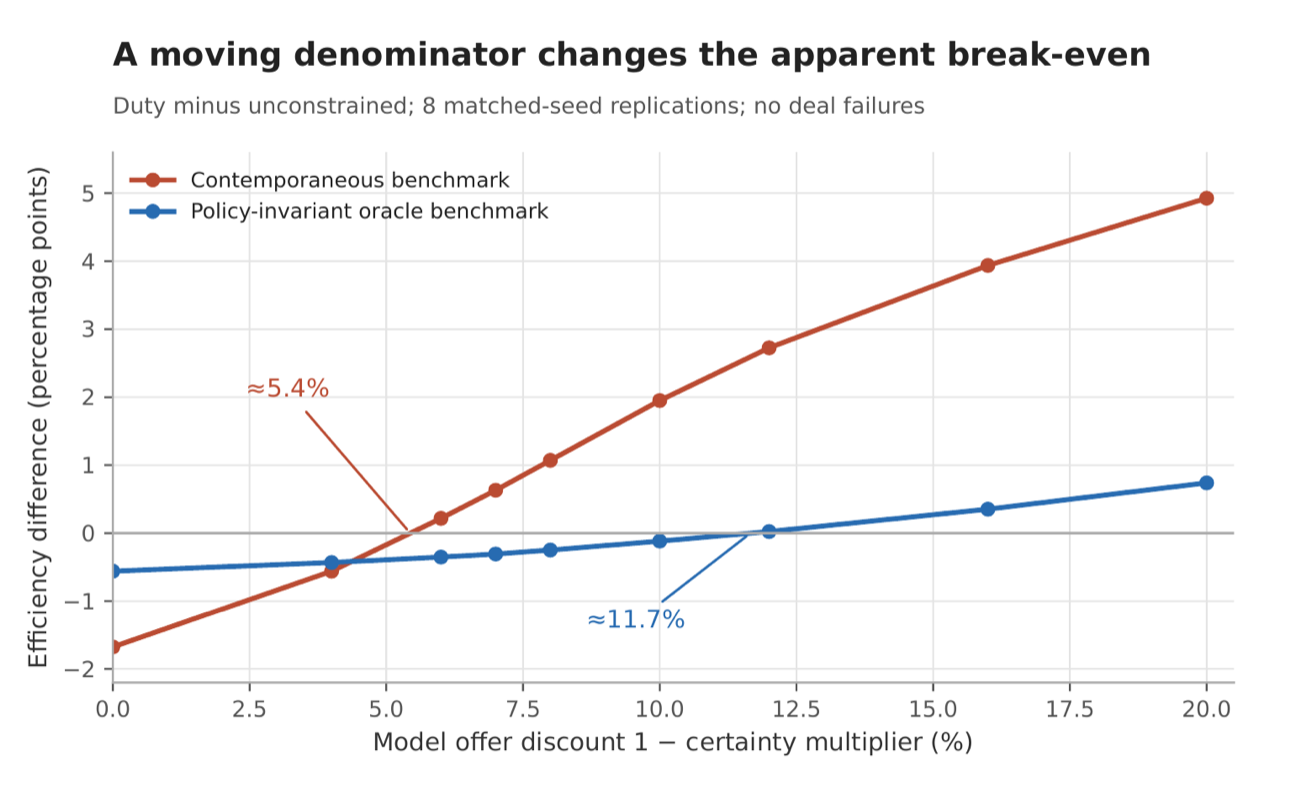
- 5.4% vs 11.7%the offer discount at which the duty stops costing value, measured against buyers still waiting and against a fixed benchmark (11.7%, 95% interval 11.5–11.8)
- 1.4–2.5×how much access counted over the whole run understates each instrument's effect on a cohort followed to purchase or exit
- 2rankings of the same instruments: tuned to one full-run access gain, a constant charge keeps more value than the duty; tuned to one cohort gain, the duty keeps slightly more
- 9.8% → 9.5%owner-occupiers who leave without buying at New York City proxy values, and with the cash discount removed: a comparison within the illustrative model
Why it matters
- Policies aimed at institutional or cash buyers are usually judged by an access number and an efficiency number. How each is measured can decide which policy looks best.
- An efficiency benchmark computed over the buyers still waiting moves with the policy itself. A two-period example in the paper shows why.
- Access measured over the whole run mixes cohorts. Following one cohort to purchase or exit gives larger effects and a different order.
What the results can tell us
The comparisons depend on an illustrative model. Two inputs use New York City records, but supply, arrivals, patience and valuations remain illustrative. Companies paying cash are a proxy for certain institutional buyers; the category includes LLCs used by individuals and does not measure closing certainty. The model omits strategic bidding, renters’ welfare and administrative costs, so its rankings are conditional model results. A separate methods manuscript, Auditing policy dependent benchmarks in allocation simulations (PDF), develops the reporting diagnostic in housing and service-queue examples. The methods paper and replication files are a separate release. This page preserves the archived housing simulation.
Cite this paper
BibTeX citation
@misc{loschi2026wedge,
  author       = {Loschi, Pablo},
  title        = {The Execution-Certainty Wedge: How Measurement Choices
                  Rank Housing-Access Instruments},
  year         = {2026},
  howpublished = {Working paper and replication package, Zenodo},
  doi          = {10.5281/zenodo.22164073}
}