
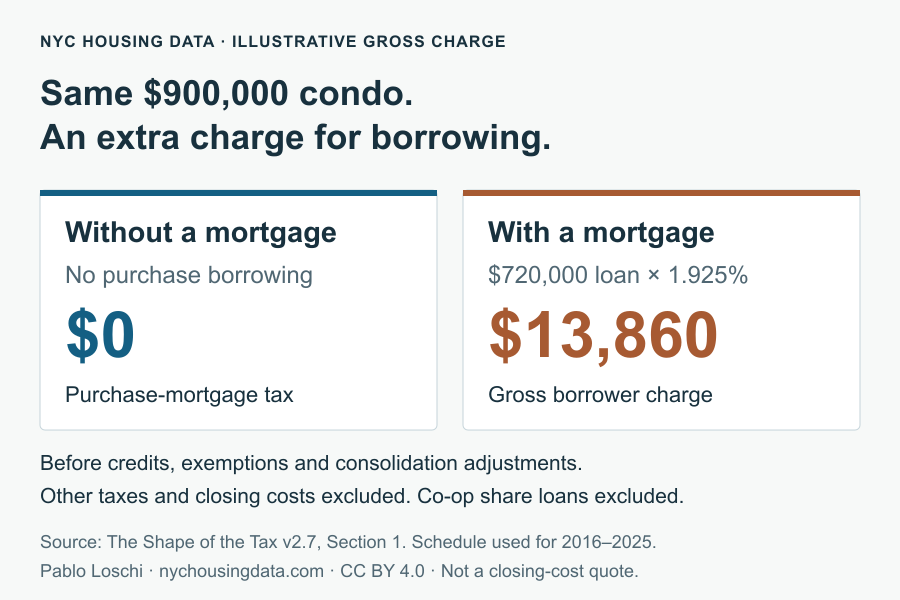
Consider a $900,000 condominium bought in either of two ways: without a mortgage, or with a $720,000 loan. Under the borrower schedule used in my study, the loan carries a gross mortgage recording charge of $13,860. The purchase without a mortgage carries no purchase-mortgage recording charge.
That difference comes from how the purchase is financed. It sits alongside taxes on the transfer of the property, even when the sale price is below the $1 million mansion-tax threshold.
A charge on the loan
The mortgage recording tax combines New York State and City levies. The City’s guidance explains the recording requirement and directs readers to ACRIS for a calculation. The tax concerns recording a mortgage against real property. Financing secured by shares in an individual co-op apartment falls outside it.
For the residential loans studied in the paper, the standard borrower schedule is 1.80% below $500,000 and 1.925% at or above that loan amount. Those percentages apply to the mortgage principal. The $900,000 condo example uses the higher rate on a $720,000 loan.
The illustration applies the gross schedule to the entire recorded loan. Actual liability can differ: credits or exemptions may apply, and a consolidation, extension and modification agreement, often called a CEMA, can change the taxable amount. The paper’s calculation does not apply those adjustments.
What the recorded loans add up to
My study links sales and recorded mortgages in Manhattan, the Bronx, Brooklyn and Queens from 2016 to 2025. Applying the standard borrower schedule to recorded principal gives a gross charge averaging 1.41% of purchase price for houses and 1.28% for condominiums in the financed sample.
Those are sample averages expressed as a share of price. They are not tax rates to apply to your own purchase. They also are not observed payments: the calculation cannot recover every credit, exemption or consolidation adjustment.
Is the distinction fair?
A buyer who can pay without a mortgage avoids this purchase-financing charge. A buyer who needs to borrow faces a statutory charge in addition to the taxes on the transfer. That raises a question for tax policy: should needing a loan change the tax attached to buying an otherwise comparable home?
The records measure the statutory difference. They cannot tell us how much ultimately falls on buyers through closing costs, sellers through prices, or lenders through loan terms. Nor does the study establish which replacement tax would be best.
The same paper examines a different feature of New York’s tax system: the sudden buyer-tax step at $2 million. That story has an interactive illustration of the 2019 thresholds. Mortgage recording charges are excluded from that tool.
Sources and methods
This article explains Pablo Loschi’s own research in The Shape of the Tax, v2.7. The example and borrower rates appear in Section 1; the gross sample charges are reported in Tables 8 and 9. Paper and analysis archive.
Official sources: NYC Department of Finance mortgage recording tax guidance; Department of Finance’s 2024 statistical profile, introduction, for the City and State components, co-op treatment and examples of credits. The illustration follows the historical schedule used in the paper and excludes the lender portion.
Original article and comparison graphic: CC BY 4.0. Credit Pablo Loschi, NYC Housing Data; keep the assumptions and source notes, and identify edits. Underlying research releases retain their own terms.