
In 2018 a house in New York City changed hands for $1,625,000. That is what the city's public sales file says, and it is what any website, appraiser or researcher working from that file will see: a sale, a date and a price.
The house never went on the market. Two relatives, or former relatives, sold it, and one of those two sellers was also the buyer. After the deed, one of them owned the whole house. It looks like a buyout within a family, the kind that often follows a divorce or an estate. Nothing about it is improper.
We know this because the people involved said so. Every deed in New York comes with a state form, the real property transfer report. Item 14 asks the parties to tick any condition that makes the transfer unusual. On this one they ticked three boxes: a sale between relatives or former relatives, one of the buyers is also a seller, and other unusual factors.
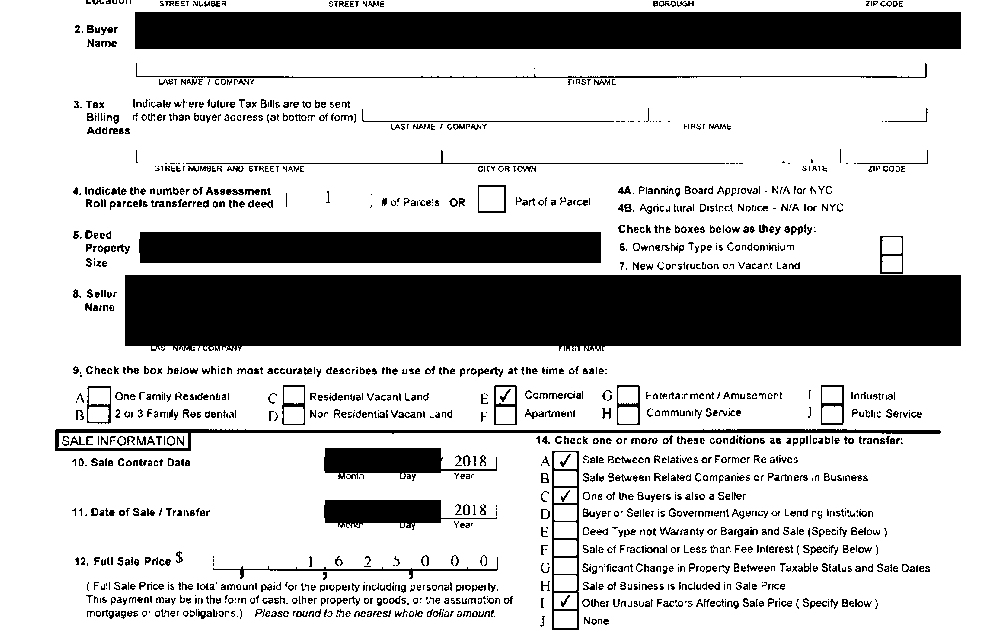
The form is filed with the deed, and anyone can open it as a scanned image on the city's records site. The boxes do not make it into the sales file most people use. There, this transfer looks like a family selling to strangers.
How often does this happen?
For my study of houses that sold twice between 2016 and 2025, I drew 60 deeds at random: 40 where buyer and seller share a surname and 20 cash purchases where they do not. Each transfer report was read with AI assistance, and I then checked every reading against the form myself. I agreed with all 60.
- Among the 40 same-surname deeds, 16 declared a sale between relatives, a buyer who was also a seller or an unusual deed type, or recorded a zero price with no transfer tax.
- Among the 20 others, 2 declared one of these conditions.
So the boxes are not rare, and a shared surname is a rough way to find them. It catches many family transfers and misses some, such as relatives with different surnames.
Missing boxes and two prices for one deed
The boxes only help when people tick them, and the forms showed two other problems.
Boxes left empty. In 9 of the 40 same-surname deeds, the same person appears on both sides, or buyer and seller give one address, yet no condition is ticked. In one, two co-owners with the same surname transferred their house to one of them, recorded a price of $0 and ticked "None". The form is often filled in by a lawyer or title clerk, and "None" is the last box on the list.
Two prices for one deed. The city's document index records an amount for every deed, and the transfer report has its own "full sale price". In 6 of the 60 deeds they differ by more than 5%:
- Two family transfers carry $375,000 and $462,509 in the index but $0 on the form.
- One shows $790,415.66 in the index, an amount to the cent that looks more like a loan balance than a price, against $400,000 on the form.
- One shows $800,000 in the index and $212,587 on the form.
- One, between people with different surnames and with no box ticked, shows $730,000 in the index and $0 on the form.
Which number is "the price" depends on which file you open.
A sale between religious orders, counted as a cash home purchase. One of the 20 deeds without a shared surname is a sale between two Catholic religious orders, for $2.1 million, with no mortgage and no box ticked. In the records it is a cash purchase of a house. It may well have been a fair price, but it is not the household sale people picture when they talk about cash buyers.
Is anyone dodging taxes? These documents cannot tell us. A low price between relatives is legal, and a gift is not taxed as a sale. Where the amounts disagree, I do not know why: it could be a part interest, a loan amount or a clerical error. What the forms do show is that labels and numbers are filled in unevenly, and that the open data passes this on without warning.
Why it matters: the cash discount
A common claim is that cash buyers get a discount, because sellers accept less from someone who does not need a bank. In the public records that looks true. When I compare the same houses bought once with a mortgage and once without, the financed purchase is about 9.7% higher.
About half of that gap disappears when I set aside the pairs where buyer and seller share a surname. A family buyout usually has no mortgage, so in the records it is a "cash" purchase, and it often comes at a family price. Those cases make cash buyers look like better bargainers than they are. The cash-buyer story has the full comparison.
How big is the problem?
Across the city it is a small share of deeds with a large effect on some numbers. In the linked dataset built from the city's records, 11,021 of 296,165 house and condominium deeds from 2016 to 2025 have a buyer and seller with the same surname, about 1 in 27. Another 44,480 give the same mailing address for both sides, which includes family transfers but also lawyers and managing agents. Among house sales without a mortgage, 5.7% have a shared surname, against 2.3% of financed sales.
- The overall price level. A few percent of sales at family prices barely moves a citywide average or a broad price index.
- Comparisons between groups. Statistics that compare cash buyers with borrowers, or one kind of buyer with another, are different. Family transfers land on one side of the comparison, and in my data setting aside same-surname sales removes about half of the measured cash discount. The surname is only a proxy, so that does not prove relatives cause half the gap.
- Foreclosures. When a lender takes back a home, the deed can record an amount set by the auction or the debt. Those deeds shift the timing of a house-price index through the 2008 crisis. In Philadelphia and New Jersey, where the rules set lower amounts, the same deeds make the crash look deeper: by about 10 log points in Philadelphia and 3 in New Jersey.
Where it reaches
Policy. In 2026 New York legislators weighed a 1% tax on home purchases of $1 million or more made without a mortgage, defended partly by the cash discount. In the public records about 3,300 house and condominium purchases of that size a year have no mortgage, which at 1% would raise roughly $106 million before anyone changed behaviour. Companies make up 40% of those purchases, and some of the rest are relatives moving a house within the family. Before a tax like this is designed or argued about, it helps to know who it would hit.
Law. A deed's "consideration" is the amount the transfer tax is charged on, and it can be set by a family's agreement, a foreclosure bid or a debt. The records call all of these a price. Tax appeals and court valuations that rely on comparable sales can inherit the same mix.
Research. Economists use the gap between cash and mortgage prices to measure how much sellers value a sure closing. If family and legal amounts are mixed with market prices, that measure moves with the mix.
What would fix it
New York State already uses these boxes. When its tax department studies sales outside New York City, it drops any sale whose transfer report declares a condition, any sale of $10 or less, and any sale whose contract came more than a year before the deed. The same boxes are on every New York City form, but the city's open sales file does not carry them, so outside users cannot apply the state's own rule. Publishing the item 14 answers with each sale would let anyone separate family transfers from market sales in one step.
Until then, treat a recorded price as what it legally is: the amount written on a deed.
Sources and methods
This article explains Pablo Loschi's own research. The 60 transfer-report readings, made with AI assistance and checked one by one by the author, are in the replication files of Who Gets the House? (audit/deed_image_review); the index amounts come from ACRIS metadata in the same files. The author check, the cash-purchase counts and the Philadelphia and New Jersey results come from the house paper v3.9 (10.5281/zenodo.23414584), the dataset 1.1.0 (10.5281/zenodo.23414979) and the deed paper v1.0.11 (10.5281/zenodo.23414919). Names, addresses, exact dates and document numbers are omitted here; the replication files let a reviewer check each case. Gap estimates: 9.25 log points with all pairs and 4.87 without same-surname pairs; they describe the records and do not measure the effect of paying cash. Citywide counts: the linked NYC dataset, release 1.1.0. State exclusion rules: New York State Department of Taxation and Finance, sales criteria.
New article text and original graphics: CC BY 4.0. Credit Pablo Loschi, NYC Housing Data; retain the source and sample, and identify edits. Underlying research releases retain their own terms.